
In 2025, over eight in ten patent applications directed to Hardware for AI were allowed at the EPO as AI filings hit a record high and begin to accelerate again, Marks & Clerk’s sixth AI Report reveals.
London, 25 November 2026 – AI is expanding from the cloud. In 2025, over eight in ten patent applications directed to Hardware for AI closed at the European Patent Office (EPO) were allowed, well ahead of AI as a whole, while AI patent publications hit a record 14,049 in 2025. The findings come from the sixth annual AI Report by leading, international intellectual property firm Marks & Clerk.
Marks & Clerk has a track record of reading where AI is heading. In 2022, months before ChatGPT brought generative AI to a mass audience, its second report flagged natural language processing and generative models as the areas to watch. For a number of years, the firm has also been saying that AI's next shift would be into hardware: the chips, processors and memory that run AI, and the robots, vehicles and drones it controls. Against a backdrop of surging market demand and higher-than-average allowance rates in Hardware for AI, this year's report confirms the importance of the hardware that powers the surge in AI applications.
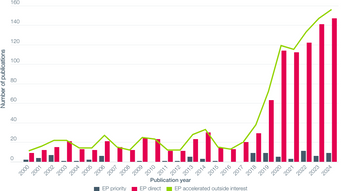
Applicants across AI are succeeding more often too. 60.7% of AI cases closed at the EPO in 2024 were allowed, up from 45.5% in 2015, and the 2025 figures so far are higher again. Publications grew 9.8% in 2025, after only 1.7% the year before.
Hardware for AI accounts for 2,437 of the 105,651 AI publications at the EPO since 2000. Its yearly total has fallen slightly from a peak of 399 in 2022 to 333 in 2025, however the wider Hardware AI group, which also covers robots, vehicles, drones and other machines controlled by AI, grew by 121 publications in 2025, all of it in Machines Controlled by AI.
Key findings:
- Most Hardware for AI starts outside of Europe. US applicants account for 43.1% of Hardware for AI publications of 2021 to 2025, almost twice the share of applicants from EPC states (22.9%). Chinese (15.7%) and Korean (10.2%) applicants hold a larger share than in AI as a whole (9.3% and 5.7%). Overall, 73.2% of Hardware for AI publications claim priority from a first filing outside Europe, including 48.7% from the US and 12.5% from China.
- The Republic of Korea leads per capita. It recorded 17.3 AI publications per million inhabitants in 2025, ahead of the US (14.8), Japan (9.5) and the EPC states taken together (7.9). It also leads in per capita Hardware for AI publications.
- Innovation is moving across the hardware stack. Compilers, design tools and system software became the largest identifiable Hardware for AI sub-domain by 2025, while activity in neural-network accelerators has tapered off since its 2020 peak. European applicants focus most heavily on neuromorphic and analogue circuits.
- Hardware proprietors are cautious about the Unified Patent Court. Of the AI patents granted in 2025, 22.6% had been registered as Unitary Patents by the end of the year and 41.2% had been opted out of the UPC, down from a peak of 53.7% for patents granted in 2022. Hardware for AI proprietors take up the Unitary Patent less (14.1%) and opt out more (54.3%).
- Divisional applications are more common in hardware. They made up 14.7% of Hardware for AI publications in 2025, against 5.8% for AI as a whole. Across AI, divisionals were allowed more often than other cases in every closure year from 2015 to 2025 (73.2% against 59.6%).
- Prior art objections against every claim is not fatal. A category X citation (a document relevant to patentability) against every claim is the norm for Hardware for AI applications filed directly at the EPO (74.1% of those with a search report), yet 57.6% of those that have closed were still allowed.
- Oppositions remain rare. Only 459 of the 33,777 AI patents granted by the end of 2025 (1.4%) have been opposed, and none of the 735 Hardware for AI patents identified in the report.
- New entrants keep arriving. 22.2% of Hardware for AI publications in 2025 came from applicants new to the field, up from 18.2% in 2023, although two thirds of those came from applicants that already had AI publications at the EPO.
This year’s report also looks beyond the EPO, with insights from Marks & Clerk’s Hong Kong and Canadian teams. In China, AI hardware patenting is booming. The CNIPA recorded 6,404 Hardware AI publications in 2025, more than three times the EPO’s total, and grants in the field have risen 16-fold since 2018. Chinese applicants file overwhelmingly at home, where they hold 88% of publications, against under 9% at the EPO. Canada, meanwhile, may be about to become one of the friendlier places to patent AI hardware. Under draft guidance now out for consultation, an algorithm that simply runs faster, or that makes a large language model hallucinate less, could qualify. Applied AI is a different story. Canada can require physical equipment to be recited in the claim, which can make a patent harder to enforce, while the EPO accepts software-only claims.
What the authors say:
Mike Williams, Partner, AI specialist at Marks & Clerk, said: " In 2022, months before ChatGPT made generative AI a household name, our filing data showed that generative models were the area to watch. For several years now, that data has also pointed to AI expanding from the clouds and moving into the physical world, and this year's figures are the strongest confirmation yet. Patent applications are filed long before products reach the market, which makes them one of the earliest signals of where technology is heading. The good news for innovators is that AI applications are being allowed at the EPO more often than ever, a sign that applicants now understand what the Office expects of a protectable AI invention."
James Stott, Partner, Hardware specialist, Marks & Clerk, said: "Hardware for AI is essentially the engine that powers the algorithms that have been so widely adopted. Innovators should have no concerns about the inherent patentability of their AI hardware, with eight in ten cases closed in 2025 being allowed by the EPO. The harder questions are strategic. Following a surge in activity relating to neural-network architectures peaking around 2020, interest now appears to be diversifying beyond first-generation accelerators into AI-assisted chip design, memory and neuromorphic circuits. Hardware proprietors are noticeably more cautious about the Unified Patent Court than the wider AI field. With nearly three quarters of these cases starting outside Europe, applicants need a European strategy built in from the very first filing."
Marks & Clerk's track record:
AI patent applications represented by Marks & Clerk are allowed more often than the EPO average. Of the firm's AI cases closed in 2021 to 2025, 72.4% were allowed, against 62.5% of all AI applications closed at the EPO in those years, a lead of almost 10 points. The firm's allowance rate has been above the overall rate in every year from 2018 to 2025.
The report is the sixth in a series from Marks & Clerk that began in 2021. Earlier editions mapped the baseline of AI filings (2021), commercial maturation and Korea's rise (2022), the generative wave (2023), AI and the energy transition (2024) and the quantum frontier (2025). Attorneys from the firm's software, energy, med-tech, quantum and electronics practices contributed to this year's edition.
Click here to access the full report now.